The Hedge

(Italian test below, after English)
In 2002 I was finishing one long project and beginning another.
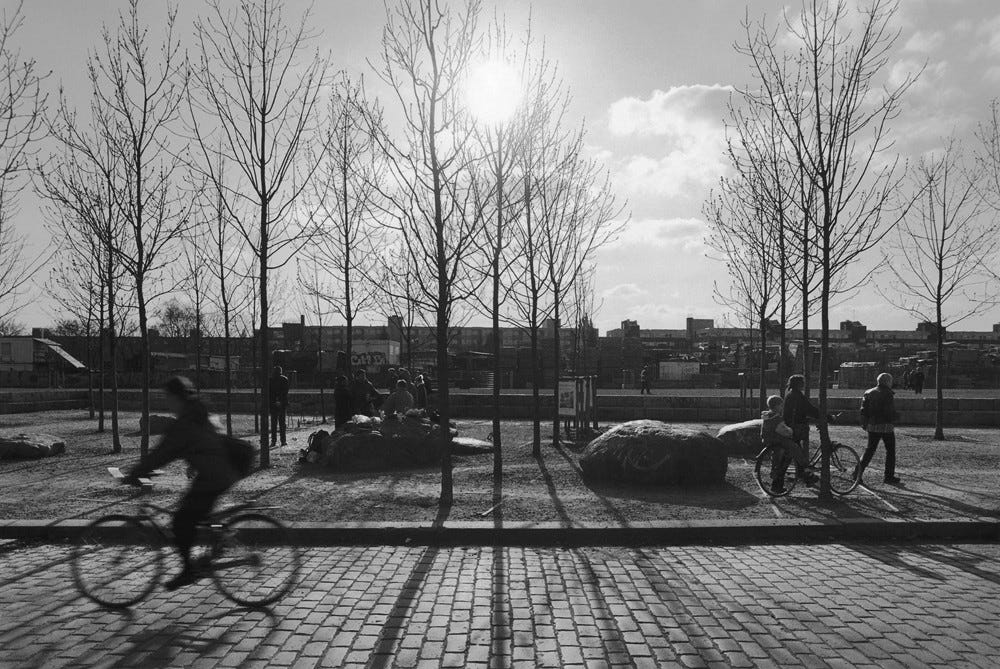
This Berlin image was made in Mauerpark — eight years after the Wall came down, people were still learning how to simply be there, to sit in a little sun, on what had been a death strip. I was still working with figures, still letting perspective organize the frame. The trees push toward the light, the shadows push toward us, the eye follows. Classic spatial hierarchy, even if simplified. I knew it, it was oppressing me, I was trying to escape it — I just didn’t know how yet.
The problem is that perspective is a claim to power. Everything in the frame serves a single vanishing point. La Città Ideale — that Renaissance obsession with rational order — is beautiful and completely tyrannical. Photography inherited that tyranny as unavoidable optical law, without ever questioning what it means.
Then I remembered Leopardi. The first lines of L’Infinito: a hill, a hedge, and a horizon the hedge conceals. The infinite is not visible — it is the obstruction itself that activates thought. The imagination fills what the eye cannot reach, and that space is larger than any vanishing point could ever deliver.
The reeds image came from that impulse. Same backlight, vertical elements acting as a screen. No vanishing point. Three layers — fallen reeds, standing reeds, clouds — held together only by tone and texture. The eye cannot travel into the image. It reads it laterally, like a wall. Like a hedge.
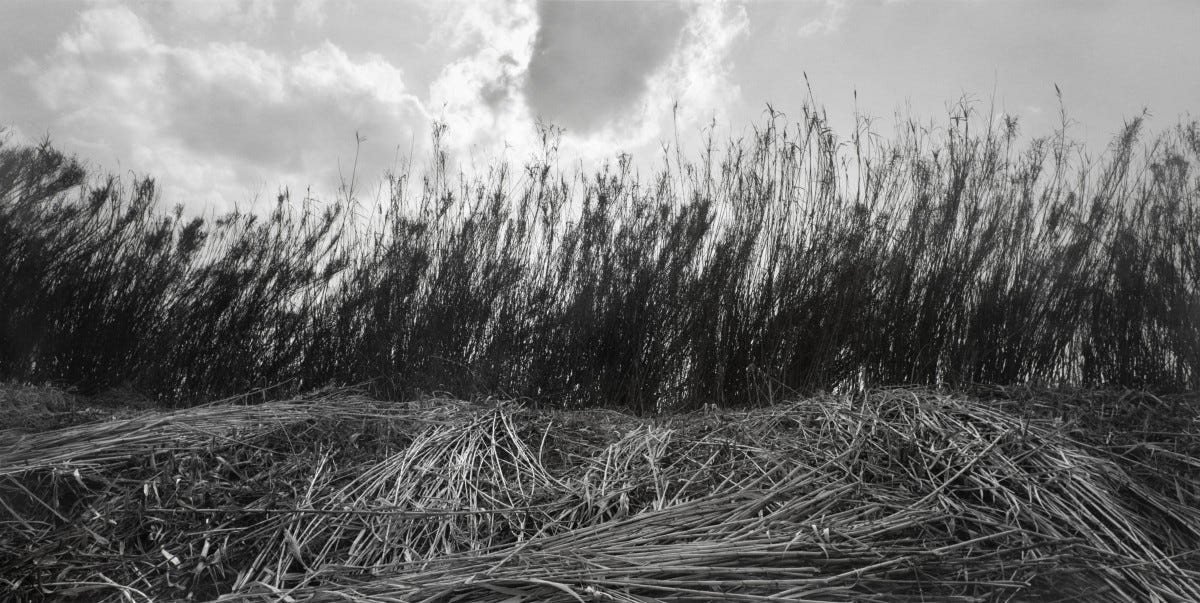
I wasn’t trying to photograph nature. I was trying to find out if a photograph could suggest space without surrendering to perspective. If the infinite could be present in a Close Landscape precisely because the view of the horizon is blocked.
**************************
Nel 2002 stavo concludendo un lungo progetto e ne stavo iniziando un altro.
L’immagine di Berlino è stata scattata al Mauerpark — otto anni dopo la caduta del Muro, la gente stava ancora imparando a stare lì, magari solo per godersi un po’ di sole, su quello che era stato un corridoio della morte. Lavoravo ancora con le figure, lasciavo ancora che la prospettiva organizzasse il fotogramma. Gli alberi puntano verso la luce, le ombre puntano verso di noi, l’occhio segue. Era una gerarchia spaziale classica, anche se semplificata. Lo sapevo, mi opprimeva, cercavo di sfuggire, non sapevo ancora come.
Il problema è che la prospettiva è una pretesa di potere. Tutto nel fotogramma serve un unico punto di fuga. La Città Ideale — quell’ossessione rinascimentale per l’ordine razionale — è bella e completamente tirannica. La fotografia ha ereditato quella tirannia (è ineluttabile legge ottica), ma senza interrogarsi sul suo significato.
Poi ho ripensato a Leopardi. I primi versi dell’Infinito: un colle, una siepe, e un orizzonte che la siepe nasconde. L’infinito non è visibile — è dall’ostacolo che attiva il pensiero. L’immaginazione riempie ciò che l’occhio non può raggiungere, e quello spazio è più grande di qualsiasi punto di fuga.
L’immagine delle canne è nata da quell’impulso. Stesso controluce, elementi verticali che fungono da schermo. Ma nessun punto di fuga. Tre strati — canne cadute, canne in piedi, nuvole — tenuti insieme solo dal tono e dalla texture. L’occhio non può viaggiare nell’immagine. La legge lateralmente, come una parete. Come una siepe.
Non stavo cercando di fotografare la natura. Stavo cercando di capire se una fotografia potesse suggerire lo spazio senza arrendersi alla prospettiva. Se l’infinito potesse essere suggerito anche in una fotografia proprio perché la vista dell’orizzonte è impedita.